
Remember When Crayola...
The Tools of Propaganda and Racism

The Real History of Coloring: A Spectrum of Systemic Erasure
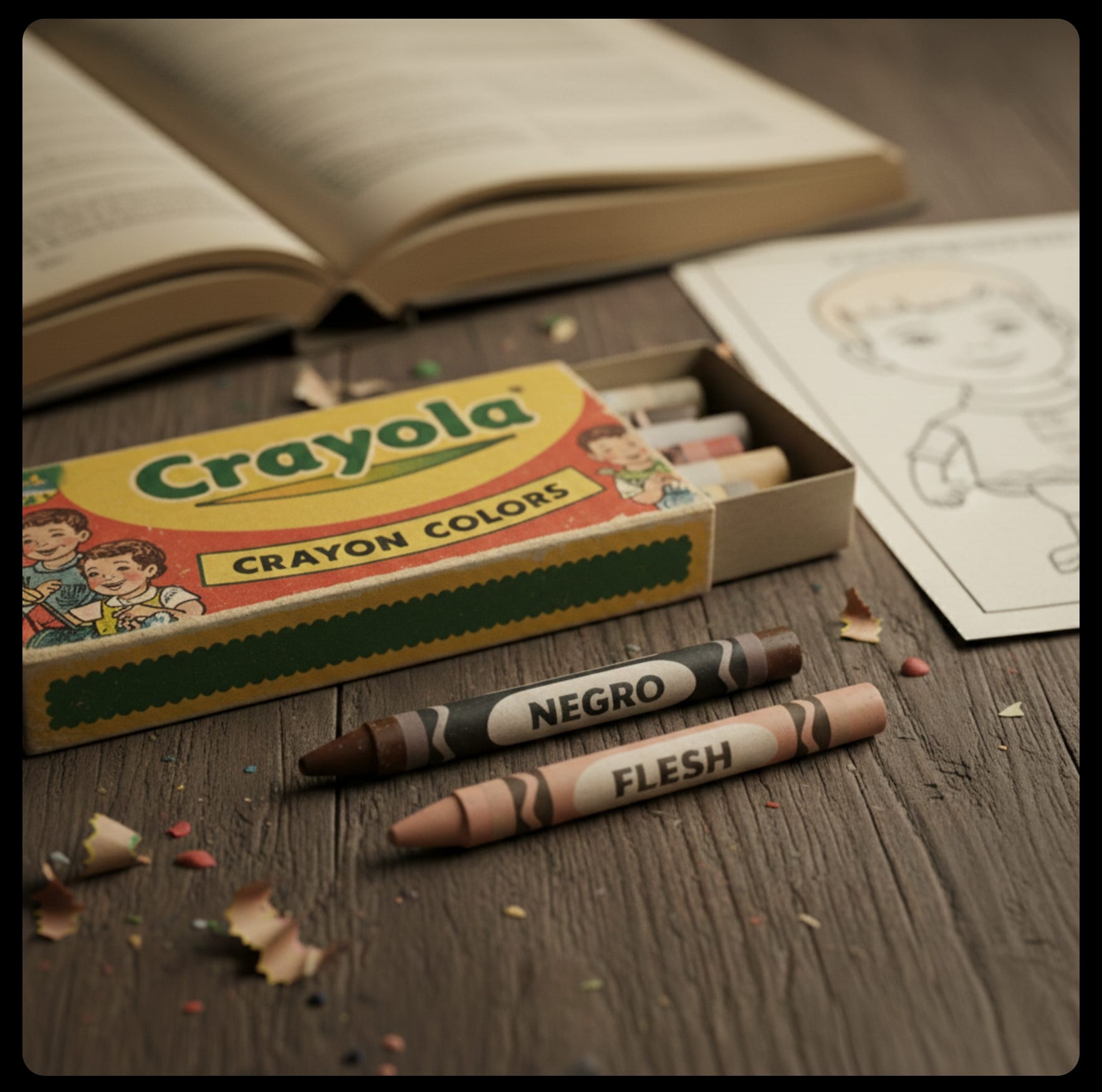
For generations, the humble box of Crayola crayons sat at the intersection of childhood wonder and insidious cultural programming. Beyond the vibrant primary hues, two particular names—"Flesh" and "Negro"—served as unwitting, yet stark, monuments to the systemic biases woven into the very fabric of mid-20th century American society. These weren't mere semantic choices; they were institutionalized affirmations of a specific racial hierarchy, meticulously packaged for tiny hands.
The Socioeconomic Gatekeeper: The 64-Pack Hierarchy
In the mid-20th century, the landscape of the classroom was as much about class as it was about color. While the basic 8 or 16-count boxes were the standard for the working class, the Crayola 64-pack—complete with its built-in sharpener and tiered rows—was a visceral symbol of wealth and status.
To possess the 64-pack was to own the full spectrum of available reality. It was a tactical advantage in the sandbox of social hierarchy. In these larger, more expensive sets, the inclusion of "Flesh" and "Negro" wasn't just a labeling issue; it was a curated experience accessible only to those with the financial capital to afford the "full" world. For the child in a lower-income household, the world was literally more limited, but for the wealthy child, the world was presented in high-fidelity, complete with the labels that reinforced who belonged and who was "othered."
The "Negro" Crayon: A Hue of Erasure (1949–1962)
The "Negro" crayon, introduced in Crayola's No. 48 box in 1949 and featured prominently in the luxury 64-pack, was a visceral example of nomenclature as societal inscription. While its pigment was indistinguishable from what would eventually become "Black," the label itself was a stark echo of a segregated era.
The word "Negro," though in common usage at the time, carried the heavy historical baggage of slavery and Jim Crow. To label a crayon "Negro" was to elevate a specific racial descriptor to the status of a primary color, implicitly framing Blackness as a singular, immutable, and often subordinate category within the collective imagination. This designation began its decline not due to internal corporate enlightenment, but under the external pressure of the burgeoning Civil Rights Movement. In 1962, Crayola officially retired "Negro" from its palette, replacing it with the more neutral, descriptive "Black."
The "Flesh" Crayon: Defining "Normal" (1950–1962)
Even more insidious was the "Flesh" crayon. This pale, pinkish-tan hue was presented as the universal standard of human skin. For any child whose complexion deviated from this narrow definition—the vast majority of the global population—the "Flesh" crayon served as an early, profound lesson in their own "otherness."
It implicitly declared that "flesh" was synonymous with Caucasian skin, relegating all other tones to an unnamed, undefined, or simply unrepresented status. This crayon was a Primal rejection baked into the very tools of creativity. The act of reaching for the "Flesh" crayon to depict a person and finding it did not match their own skin was a microaggression—a foundational moment where institutional branding undermined individual identity. Like its counterpart, "Flesh" was renamed in 1962, becoming "Peach."
The Pigmented Legacy: Systemic Bias in a Cardboard Box
The story of Crayola's "Flesh" and "Negro" crayons is a chilling reminder of how systemic biases are materialized, branded, and disseminated. These crayons were artifacts of supremacy, teaching generations that the dominant culture's perspective was the universal truth, while the "built-in sharpener" of the 64-pack ensured that this message was delivered with the sharpest possible clarity to those at the top of the economic ladder.
In retrospect, these humble coloring tools offer a sharp illustration of what happens when the "logic of the time" is blinded by its own reflection. They stand as a testament to the fact that the ugliness of societal prejudice often begins with the simplest instruments, etching indelible messages into the minds of those too young to question the hand that holds the crayon.
Even though the renaming occurred in 1962, those crayons persisted well into the 1980s. I was born in '78, I gripped the Negro and Flesh, wrappers and reprehensible whispering hierarchies etched in wax. Even the paper wrapper of the Negro crayon was different from the rest. Pay attention to the little things because they aren't always so little. Sometimes they're actually subliminally geared towards hatefulness.
You’re exactly right, Robert. This isn't just about a box of crayons; it’s about the architectural framing of a hierarchy that begins before a child even learns to read. When we label 'Caucasian' as the default for sugar, flour, and 'flesh,' we are witnessing the systemic bleaching of the human experience.
It is a slow-drip indoctrination that requires constant, aggressive repetition to undo. We have to say it—and keep saying it—until the lie bubbles burst under the weight of the raw, unredacted truth.
If we mirror the persistence of the 'top-down' narratives we see from the podium, we can force a frequency shift. We aren't just popping bubbles; we are reclaiming the 'sacred geometry' of a reality that hasn't been scrubbed clean for the comfort of the privileged. We keep repeating it until the truth isn't just obvious—it’s undeniable. 🤔
“… and the cane sugar was bleached Caucasian. And the flour was bleached Caucasian.”
The turning of the Caucasian as a “flesh” color compared to a “negro” color clearly made one a flesh and the other based on “know your place”, an abhorrent destruction of a people even at the fucking Crayola level. If a minority can"t be left to heal because the children will say “Something is up with these crayons dad and mom?” The White privilege statement is nothing to be proud of especially when they fuck with children in any race. No one wants to associate with someone and something who just can't stop being genetically ignorant and weaker through unfounded statements.
Angela does it again. I love ya sister. You peel away the veneer and show the pock marks of a very sick condition, rabid with what ever it touches. Not everything needs whitewashed.